The Gemmotherapy Production Process: From Bud to Bottle
In gemmotherapy, the production process is not a secondary consideration. It is the primary determinant of whether the final preparation carries the biological complexity that gives gemmotherapy its clinical value, or whether it is reduced to a botanical extract of ordinary quality. The entire therapeutic rationale of gemmotherapy depends on the preservation, from the moment of harvest to the moment of use, of the growth factors, phytohormones, nucleic acid precursors, and enzymatic cofactors that are present in the embryonic tissue only in living, freshly harvested material.
Understanding the production process is also the foundation for understanding why Herbolistique preparations are clinically different from the majority of gemmotherapy products on the market. The standard production method as practised by most manufacturers is the starting point of this page. The Herbolistique method, which departs from that standard at every critical juncture, is the destination.
The Harvest Window: A Matter of Days, Not Seasons
Why Fresh, Not Dried: The Gemmotherapy Production Process Non-Negotiable Principle
Conventional herbal medicine typically uses dried plant material. Gemmotherapy categorically rejects this approach, and the rejection is not a matter of tradition but of biochemistry. The growth factors, phytohormones, and nucleic acid precursors that carry gemmotherapy's therapeutic action are heat-sensitive, oxidation-sensitive biological molecules. The drying process that herbalism uses to preserve mature plant material destroys these compounds. What remains after drying is the stable secondary metabolite fraction. What has been lost is precisely the embryonic intelligence that defines gemmotherapy.
The principle of fresh, immediate processing is therefore fundamental. No freezing at any stage of production, no delay between harvest and maceration, and no drying. The embryonic tissue must pass from the living plant to the maceration medium without interruption. This principle defines the operational requirements of a genuine gemmotherapy manufacturer and is the primary standard by which production quality should be evaluated.
The Industry Standard of Gemmotherapy Production Process: What Most Manufacturers Do
To understand what makes Herbolistique different, it is necessary to understand the baseline against which it differs. The standard commercial approach to gemmotherapy production uses approximately 5 kg of fresh buds per 100 kg of finished macerate, a concentration level that represents roughly 5% bud density by weight. This is the prevalent practice across approximately 95% of the gemmotherapy market.
At 5% concentration, a preparation will contain the biochemical profile of the embryonic tissue, but in a diluted form that limits the depth and precision of its terrain-level action. The clinical effects are present but attenuated. For practitioners and informed users who have experienced genuinely concentrated gemmotherapy preparations, the difference in clinical response is not subtle. It is the difference between a signal that reaches the terrain clearly and one that is present but insufficiently structured to produce a consistent terrain-level shift.
The HERBOLISTIQUE Production Process and Concentration Metod
Market producion standard
~5 kg of fresh buds per 100 kg of macerate (5% bud density)
Herbolistique method
10 to 17 kg of fresh buds per 100 kg of macerate: up to 3x the industry concentration
Concentration basis
Maceration duration
Water quality
Visible indicator
No freezing
Source plants
The Herbolistique Concentration Method: Up to 3x the Standard
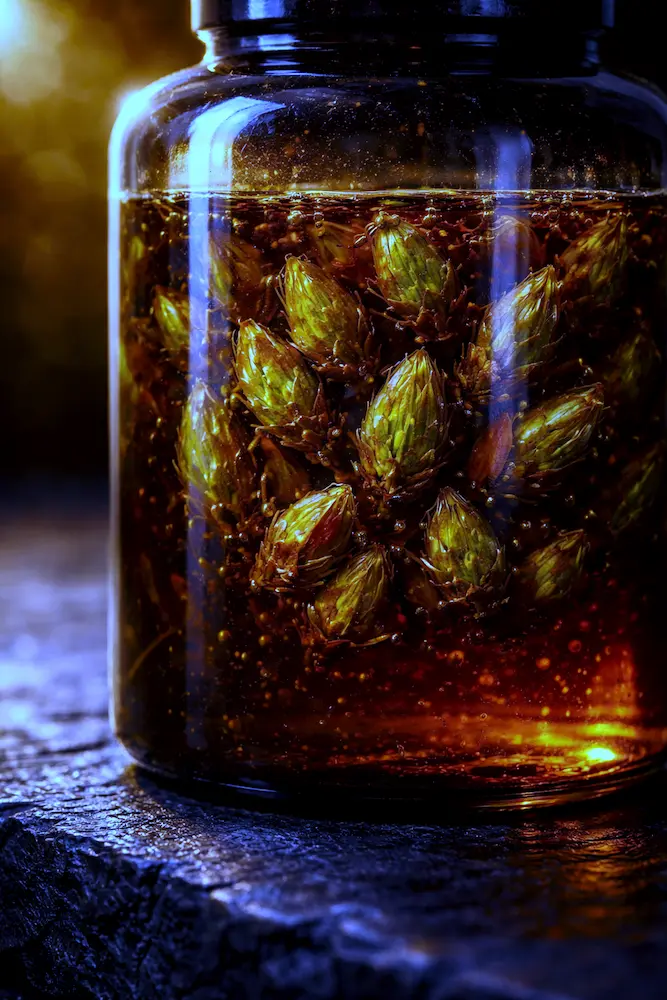
The Herbolistique production method is built on a different philosophy of concentration. Rather than applying a simple weight ratio, Herbolistique calculates bud density on the basis of dry matter equivalence: the 5% target concentration is calculated against the dry weight of the bud material rather than its fresh weight. Because fresh buds contain significant water content, achieving a true 5% dry matter concentration requires between 10 and 17 kg of fresh buds per 100 kg of macerate, depending on the species and its moisture content at harvest.
The result is a preparation that contains up to three times the active compound density of a standard-concentration gemmotherapy product, with a correspondingly deeper biochemical profile, a more structured biological signal, and a more consistent and measurable terrain-level response. The deeper colour of the extract is the visible indicator of this concentration: a Herbolistique macérat is measurably darker than a standard preparation of the same species, a direct reflection of the higher bud content suspended in the solvent.
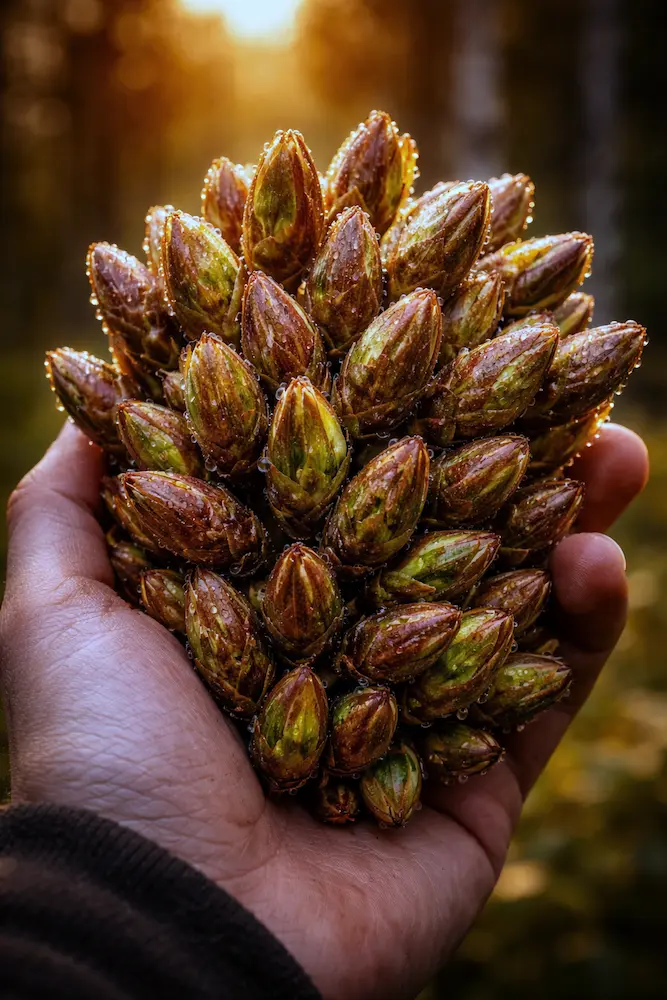
For the practitioner comparing clinical responses across products, and for the informed individual who has tried multiple gemmotherapy brands, this concentration difference is the most direct explanation of why Herbolistique preparations produce the results they do. More embryonic tissue in the macerate means more growth factors, more phytohormones, more nucleic acid precursors, and more of the biological complexity that the terrain-level action of gemmotherapy depends on.
The Macération: 21 Days in a Triple Solvent
Following Pol Henry's original protocol, the fresh bud material at Herbolistique concentration is macerated for 21 days in a triple-solvent medium of water, alcohol, and glycerin. The 21-day maceration period is not arbitrary. It is the duration at which the solvent has fully penetrated the embryonic tissue cells and extracted the complete spectrum of both water-soluble and fat-soluble active compounds.
The triple-solvent composition is deliberate and necessary. Water alone extracts water-soluble compounds but fails to capture the fat-soluble growth factors and phytohormones. Alcohol alone extracts the fat-soluble fractions but degrades the more sensitive biological molecules. Glycerin provides the preservative stability that allows the most thermally sensitive compounds to remain biologically intact throughout the maceration period. The three solvents together achieve a complete extraction that no single solvent can replicate.
The result is the macérat mère: the mother extract. This is the full-complexity preparation that contains the complete biochemical profile of the embryonic tissue in concentrated form, ten times more concentrated than the finished product, and the foundation from which the final 1DH preparation is made.
The Plocher Water: A Quality Layer Beyond the Standard
One of the distinctive elements of the Herbolistique production process is the use of Plocher-revitalized water as the aqueous component of both the maceration solvent and the diluent. The Plocher method, developed by the German researcher Roland Plocher, uses silica-based catalysts and vibrational field treatment to reorganise the molecular structure of water, restoring the ordered, clustered arrangement associated with natural spring water at source.
The rationale for this choice is biocompatibility: water that has been restructured to its natural molecular organisation is understood to present the biologically active compounds of the macérat mère in a more accessible and more biologically recognisable form. The use of revitalized water is consistent with the broader Herbolistique commitment to preserving and enhancing the biological intelligence of the preparation at every stage of its production, not only at the moment of harvest.
The 1DH Dilution and Dynamisation
The macérat mère is then diluted to the standard 1DH (first decimal Hahnemannian) potency: one part macérat mère to nine parts of the water-alcohol-glycerin diluent. This dilution step, introduced by Max Tétau, is immediately followed by dynamisation: vigorous mechanical succussion of the preparation.
Dynamisation, borrowed from homoeopathic pharmacy, refines the biological information of the preparation. It is not simply a mixing step. The mechanical succussion modifies the relationship between the active compounds and the solvent medium, enhancing the clinical precision of the preparation and reducing the risk of overstimulation in sensitive individuals. At 1DH concentration, measurable quantities of the active compounds remain present in the final preparation: gemmotherapy at this potency is not operating in the realm of infinitesimal homoeopathic dilutions, but at biologically relevant compound concentrations.
The HG Line: Alcohol-Free Without Compromise
The Herbolistique HG line (Herbolistique Glycériné) replaces the alcohol component entirely with glycerin throughout both the maceration and dilution stages, producing an alcohol-free preparation with identical active compound content and the same clinical indications as the standard preparation. The same premium concentration standard, the same 21-day maceration, and the same Plocher water are applied to HG line production.
The HG line extends the clinical applicability of Herbolistique preparations to populations for whom alcohol is contraindicated: children, pregnant women, individuals observing alcohol abstinence, and those with specific cultural or clinical reasons to avoid even trace alcohol content. It is not a reduced or simplified version of the standard preparation. It is the full Herbolistique production standard applied with a glycerin-only solvent system.
Quality Markers: What to Look For in Any Gemmotherapy Product
The gemmotherapy market contains products of widely varying quality. For any product claiming to be clinical-grade gemmotherapy, the following markers should be verified:
Fresh, not dried, source material. The non-negotiable foundation. Dried bud preparations are not gemmotherapy in the clinical sense.
Immediate on-site maceration after harvest. Material transported before maceration will have degraded active content.
No freezing at any stage. Freezing damages the growth factor and nucleic acid fractions as effectively as drying.
Concentration method and bud density. Ask for the kg of fresh buds per 100 kg of macerate. The answer reveals immediately whether the product meets a clinical concentration standard or a commercial one.
Triple-solvent maceration. Single-solvent preparations capture only a fraction of the embryonic tissue's biochemical spectrum.
21-day maceration duration. Shorter maceration periods produce incomplete extraction of the full active compound profile.
1DH dilution with dynamisation. The clinical standard. Different potencies or absence of dynamisation do not meet the benchmark established by clinical practice.
Certified organic or wild-harvested source plants. Embryonic tissue concentrates pesticide and chemical residues as effectively as beneficial compounds. Organic or wild-harvested sourcing is not optional for a clinically rigorous preparation.
Herbolistique: Production Standards That Set a Different Benchmark
Every preparation in the Herbolistique range is manufactured to the premium concentration standard described on this page: 10 to 17 kg of fresh buds per 100 kg of macerate, 21-day triple-solvent maceration with Plocher-revitalized water, 1DH dilution with dynamisation, organically certified or wild-harvested source plants, and no freezing at any stage. The HG alcohol-free line applies the same standards throughout.
Explore the Full Herbolistique Gemmotherapy Range
The complete Herbolistique range is available through the Herbolistique Cyprus online store, manufactured in France from organically certified or wild-harvested plants with immediate on-site maceration and no freezing at any stage of production.
Explore Gemmotherapy Further
How Gemmotherapy Works — The mechanisms: growth factor signalling, terrain-level action and organ affinity explained.
What is Gemmotherapy? — The complete foundational introduction to plant bud therapy.
Gemmotherapy vs Herbal Medicine — What distinguishes the two disciplines clinically and scientifically, and where they complement each other.
Gemmotherapy in Cyprus — Why the island has particular resonance for this discipline, and how Herbolistique Cyprus fills the market gap.