Gemmotherapy vs Herbal Medicine:
The Key Scientific and Clinical Differences
The question of gemmotherapy vs herbal medicine is among the most persistently misframed in natural health. Both disciplines are plant-based, both use natural preparations, both are positioned within the broader landscape of natural and complementary health. But the similarity ends at the plant itself. What gemmotherapy uses from the plant, how it extracts it, and what it uses it for are fundamentally different from every dimension of classical herbalism. This page traces those differences precisely.
Gemmotherapy vs Herbal Medicine: Which Tissue, Which Moment
Herbal medicine uses mature plant tissue: leaves, flowers, bark, roots, fruits, and seeds, harvested when the relevant active compounds are at their fullest development in that tissue type. The biochemical target is the secondary metabolite fraction, the alkaloids, flavonoids, terpenes, essential oils, and glycosides that the plant produces as part of its mature metabolic and defence chemistry.
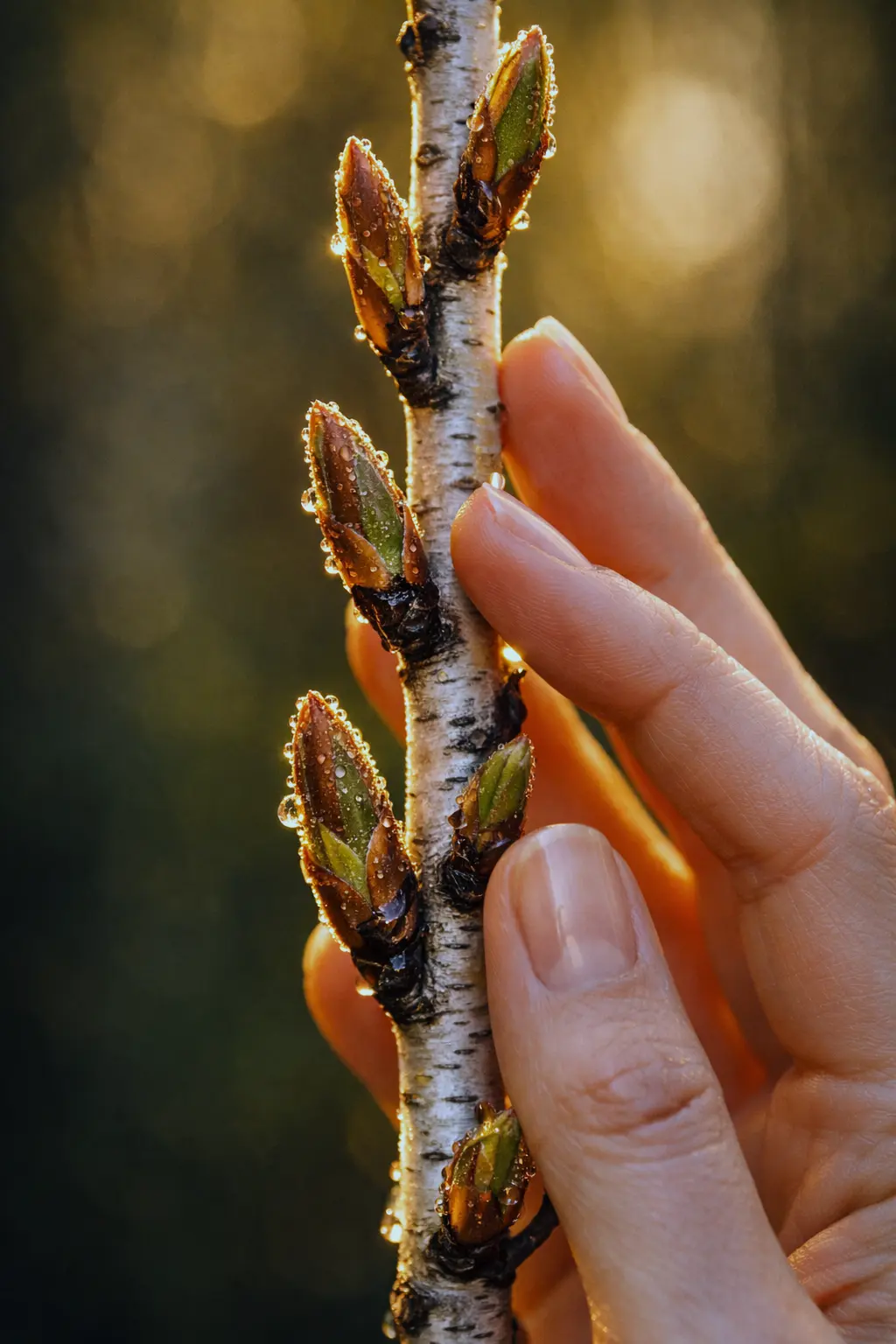
Gemmotherapy uses embryonic plant tissue: buds, young shoots, and rootlet tips, harvested at the moment of their maximum biological activity in the spring growth cycle. The biochemical target is the primary growth and regulatory fraction, the phytohormones, growth factors, nucleic acid precursors, and enzymatic complexes that the plant concentrates in its growth points as part of its developmental programme.
These two fractions are not overlapping. A mature Ribes Nigrum leaf and a Ribes Nigrum bud are biochemically distinct tissues. The mature leaf contains the phenolic compounds and vitamin C that give blackcurrant its well-known antioxidant and immune-supportive properties in classical herbalism. The bud contains the adrenal cortex-stimulating growth factors and anti-inflammatory phytohormone complexes that give it its unique terrain-level action in gemmotherapy. The same plant; entirely different biochemistry; entirely different clinical logic.
The Phytochemical Argument: What Changes at Different Growth Stages
Plant developmental biology confirms what clinical gemmotherapy has observed empirically: the biochemical composition of a plant changes dramatically between its embryonic and mature phases. This is not a subtle shift in concentration. It is a categorical difference in the types of compounds present.
In the embryonic tissue, the primary biochemical investment is in growth regulation: high concentrations of auxins, gibberellins, cytokinins, abscisic acid, nucleic acid precursors, and the enzymatic machinery of cellular division. These are the molecular tools the plant uses to build itself. They are present at their highest concentrations in the growth points at the moment of active division, and they are not present in significant concentrations anywhere else in the mature plant.
In the mature tissue, the biochemical investment shifts to defence, reproduction, and structural maintenance: alkaloids that deter predators, flavonoids and phenolics that protect against UV and oxidative damage, terpenes and essential oils that manage interactions with insects and pathogens, and structural carbohydrates that maintain physical integrity. This is the chemistry that classical herbalism has catalogued, studied, and applied therapeutically for centuries.
Neither chemistry is superior. They are different tools for different purposes. The mature plant chemistry of classical herbalism has validated applications in immune support, digestive health, antimicrobial action, and symptomatic relief. The embryonic plant chemistry of gemmotherapy has validated applications in terrain-level regulation, hormonal and inflammatory system support, detoxification, and the long-term maintenance of biological function.
Clinical Logic: Compound-Specific vs Terrain-Level
The clinical logic separating gemmotherapy vs herbal medicine is perhaps the clearest expression of how different their scientific frameworks truly are.
The clinical logic of herbal medicine is, at its most refined, compound-specific or mechanism-specific: a herb is chosen because it contains compounds known to act on a specific pathway, receptor, or biological function. Valerian is used for sleep because its valerenic acid acts on GABA receptors. Echinacea is used for immune support because its polysaccharides and alkamides stimulate innate immune function. The relationship between the compound and the clinical outcome is relatively direct. For a regulatory overview of herbal medicinal products in the EU, the European Medicines Agency’s herbal medicines framework provides the relevant scientific and legislative context.
The clinical logic of gemmotherapy is terrain-level and regulatory: a bud is chosen not because it contains a compound that acts on a specific receptor, but because its embryonic tissue has a demonstrated affinity for a specific organ system’s terrain, and because acting on that terrain supports the conditions from which healthy function in that system naturally emerges. The relationship between the preparation and the clinical outcome is mediated by the body’s own regulatory intelligence.
This distinction has a practical consequence: gemmotherapy does not produce pharmacological dose-response effects. Doubling the dose does not double the effect. Exceeding the recommended dose does not accelerate the response and risks disrupting the terrain rather than supporting it. The preparation is a signal, not a dose of medicine, and the response is the body’s own biological process rather than a pharmacological override.
The Preparation Difference: Why Method Determines Category
The preparation method of herbalism and gemmotherapy reflects their different objectives. Classical herbalism typically dries, decocts, or alcoholically extracts mature plant material, targeting the stable secondary metabolite fraction that survives these processes. The drying and heating processes that herbalism routinely uses would destroy the growth factors and phytohormones that gemmotherapy’s clinical value depends on.
Gemmotherapy requires fresh material, immediate maceration in a triple-solvent (glycerin, alcohol, and water) medium, and subsequent dilution with dynamisation. The macérat mère concentration, the 1DH dilution ratio, and the dynamisation step are not arbitrary tradition. They are the specific preparation parameters under which the embryonic tissue’s active content is most effectively preserved and presented in a form the body can act on.
A preparation described as a ‘gemmotherapy extract’ made from dried bud material, or produced through conventional herbal extraction methods, is not gemmotherapy in the clinical sense. The preparation method is not a quality variable. It is a categorical determinant of what the product is.
Gemmotherapy and Homoeopathy: Borrowing the Method, Not the Theory
Because gemmotherapy preparations use the 1DH potency and the dynamisation technique of homoeopathic pharmacy, they are frequently and incorrectly categorised as homoeopathic preparations. The confusion is understandable but the distinction is important.
Homoeopathy is based on two foundational principles: the law of similars (like cures like) and the principle of potentisation through high dilution, which posits that dilutions far beyond any measurable molecular presence retain the therapeutic information of the original substance through the memory of water. Gemmotherapy does not follow either of these principles.
At 1DH dilution, measurable concentrations of the active compounds of the embryonic tissue remain present. The preparation is not acting through energetic memory. It is acting through the biochemical and informational content of the diluted macérat mère. The dynamisation step enhances the biological availability of this content; it does not replace it. Gemmotherapy borrowed homoeopathic pharmacy’s preparation technology; it did not adopt homoeopathic theory.
When to Use Each: A Framework for Complementarity
Nutritional supplements address defined deficiencies or known pathway limitations with identified, standardised compounds at measured doses. Vitamin D supplementation corrects vitamin D deficiency. CoQ10 supplementation supports mitochondrial electron transport where CoQ10 is depleted. The logic is additive and targeted: identify the missing or suboptimal component, supply it in the correct amount.
Gemmotherapy provides the full biochemical complexity of the embryonic plant tissue, including compounds that have not been individually identified or standardised, acting on the terrain as a system rather than on specific isolated pathways. Its action is synergistic and regulatory rather than additive and supplementary. It cannot be understood in terms of the supplementation model because its active content is not a defined list of quantified compounds; it is a living biological complex whose components interact with each other and with the body’s regulatory systems as an integrated whole.
The distinction in gemmotherapy vs herbal medicine does not imply competition. Both disciplines have validated clinical applications and different strengths. Gemmotherapy operates most powerfully when the clinical objective is terrain-level: supporting the regulatory, hormonal, inflammatory, or detoxification environment over weeks and months. Herbal medicine operates most powerfully when the clinical objective is symptom-specific or mechanism-specific: addressing an acute presentation, supporting a defined physiological function, or providing antimicrobial or adaptogenic action in the short term.
In clinical practice, the two disciplines are frequently used together, with gemmotherapy providing the terrain-level foundation and herbal preparations addressing more specific or immediate presentations within that framework. A gemmotherapy protocol for chronic inflammatory terrain might be combined with herbal anti-inflammatory preparations for acute joint support. The terrain work of gemmotherapy improves the conditions in which the herbal preparation works; the herbal preparation addresses the immediate presentation while the terrain changes develop.
Discover Gemmotherapy at the Terrain Level
The complete Herbolistique range is available through the Herbolistique Cyprus online store, manufactured in France from organically certified or wild-harvested plants with immediate on-site maceration and no freezing at any stage of production.
Explore Gemmotherapy Further
How Gemmotherapy Works — The mechanisms: growth factor signalling, terrain-level action and organ affinity explained.
The Production Process: From Bud to Bottle — Harvest timing, macération mère, dynamisation and the quality markers of a genuine preparation.
What is Gemmotherapy? — The complete foundational introduction to plant bud therapy and its scientific rationale.
Gemmotherapy in Cyprus — Why the island has particular resonance for this discipline, and how Herbolistique Cyprus fills the market gap.